
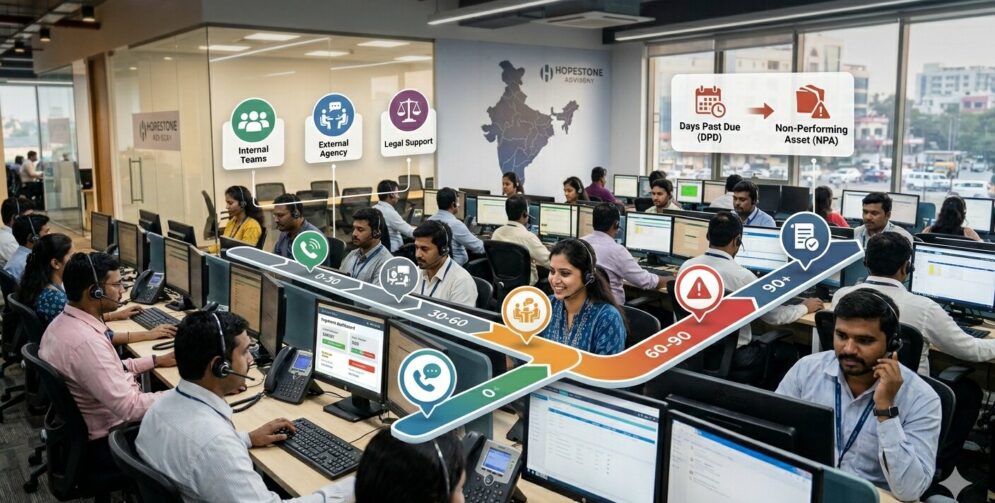
Missing a loan EMI can trigger a chain of structured actions from banks and financial institutions. Terms like DPD, NPA, recovery process, and collection framework often create confusion for borrowers and even professionals exploring the banking ecosystem.
Naturally, questions arise:
- What is the banking loan recovery process in India?
- How long does bank loan collection take?
- What happens after 90 days of non-payment?
- How do banks actually recover loans?
This guide breaks down the entire banking loan recovery process in India, explaining each stage, timeline, and collection mechanism used by banks and NBFCs — in a clear, structured, and practical way.
Whether you’re understanding the system or evaluating recovery strategies, this article provides complete clarity.
What Is the Banking Loan Recovery Process?
The banking loan recovery process refers to the structured approach used by banks, NBFCs, and financial institutions to recover overdue loan amounts from borrowers.
It involves:
- Monitoring overdue accounts
- Engaging borrowers through communication
- Negotiating repayments
- Escalating cases when necessary
In many cases, institutions rely on banking loan recovery services and professional recovery frameworks to manage large portfolios efficiently.
It is important to understand that:
Loan recovery is not random — it is a regulated, process-driven system designed to balance financial recovery with borrower rights.
When Does the Loan Recovery Process Start?
The recovery process begins immediately after the first missed EMI.
At this point:
- The account becomes overdue
- The bank initiates soft communication
- The borrower is categorized under Days Past Due (DPD)
DPD (Days Past Due) is the core metric used in the banking loan recovery process in India to track delinquency.
Stage-Wise Banking Loan Recovery Process in India
Understanding the stages is critical to grasp how recovery actually works.
Stage 1: 0–30 Days (Soft Collection Stage)
This is the early-stage delinquency phase.
What happens:
- SMS and email reminders
- Initial tele-calling
- Late payment charges applied
- Credit bureau reporting begins
At this stage:
- Recovery probability is highest
- Banks focus on reminders, not enforcement
Stage 2: 30–60 Days (Follow-Up & Engagement Stage)
If payment is still not made:
- Follow-ups become more frequent
- Structured conversations begin
- Borrowers are asked for commitment dates
- Banks try to understand financial constraints
This stage is about:
Engagement and resolution — not escalation
Stage 3: 60–90 Days (Pre-NPA Stage)
This is a critical risk stage.
What changes:
- Account flagged as high-risk
- Field visits may begin
- Formal written notices issued
- Settlement discussions may start
Stage 4: 90+ Days (NPA Classification)
As per RBI norms:
A loan becomes a Non-Performing Asset (NPA) after 90 days of non-payment.
At this stage, accounts are typically handled through structured banking loan collection services or internal recovery teams to ensure systematic recovery.
What Happens After a Loan Becomes NPA?
Once classified as NPA:
- Internal recovery teams take over
- External support from a bank loan recovery agency may be engaged
- Loan recovery outsourcing may be initiated
- Legal evaluation begins (if required)
Banks increasingly partner with banking loan recovery services to manage high-volume delinquent portfolios efficiently.
Bank Loan Collection Process in India (Detailed Flow)
The bank loan collection process follows a structured system:
1. Tele-Calling & Communication
2. Field Recovery
3. Borrower Verification
4. Payment Follow-Ups
5. Negotiation & Settlement
6. Closure & Documentation
These activities are often executed through professional banking loan collection services to ensure consistency, compliance, and scalability.
Bank Loan Collection Timeline in India
- 0–30 Days: Reminder stage
- 30–60 Days: Follow-up stage
- 60–90 Days: Pre-NPA stage
- 90+ Days: Recovery phase
Depending on complexity, the process may extend over months, especially when handled through structured banking loan recovery services.
Who Handles Loan Recovery in Banks?
Loan recovery is managed by:
Internal Teams
- Bank recovery officers
- Collection departments
External Support
- Recovery agencies
- Bank loan recovery agency partners
- Loan recovery outsourcing firms
For large-scale operations, institutions rely on banking loan recovery services for better efficiency and results.
Role of Recovery Agencies in Banking Loan Collection
A bank loan recovery agency plays a critical role in:
- Managing large delinquent portfolios
- Conducting tele-calling and field recovery
- Handling borrower engagement
- Supporting settlement processes
These agencies operate within compliance frameworks and act as an extension of institutional recovery systems.
Loan Recovery Outsourcing: Why Banks Use It
Banks and NBFCs increasingly depend on:
- Banking loan recovery services
- Third-party recovery agencies
- Portfolio-based outsourcing models
Benefits include:
- Scalability
- Cost efficiency
- Structured execution
- Improved recovery rates
This is especially relevant for:
- NPA recovery
- Delinquent loan collection
- Write-off recovery
Structured Loan Recovery Framework Used by Banks
Modern recovery frameworks include:
- Portfolio segmentation
- Data verification
- Communication strategy
- Recovery execution
- Negotiation & settlement
- Reporting & escalation
These frameworks are often implemented through specialized banking loan recovery services to ensure performance-driven outcomes.
Partner with Experts in Loan Recovery & Collections
If you are a bank, NBFC, or financial institution looking to strengthen your recovery strategy:
A structured approach backed by professional banking loan recovery services can significantly improve recovery performance.
Final Thoughts: Recovery Is a Structured System
The banking loan recovery process in India is:
- Systematic
- Regulated
- Data-driven
- Outcome-focused
Banks today increasingly rely on:
- Banking loan collection services
- Banking loan recovery services
- Bank loan recovery agency partnerships
to manage recovery efficiently at scale.
Recover Better. Recover Smarter.
If your institution is managing delinquent accounts, NPAs, or written-off portfolios, the right recovery partner makes all the difference.