
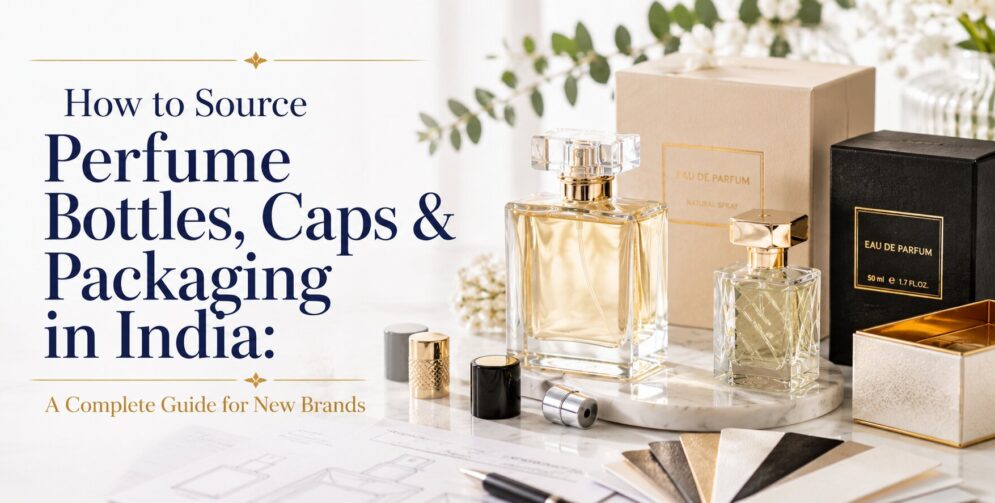
You have developed your fragrance. You have chosen your manufacturing model. Now comes the question that trips up almost every new perfume brand:
“Where do I actually get the bottles, caps, atomizers, and boxes?”
Sourcing packaging in India is not as simple as searching Google and placing an order. The market is fragmented across hundreds of suppliers, quality varies wildly, minimum order quantities can be punishing for new brands, and the wrong choice at this stage can undermine a fragrance you have spent months developing.
This guide walks you through everything — bottle types, cap and atomizer selection, packaging materials, where to source in India, how to evaluate suppliers, and how to avoid the most expensive mistakes first-time founders make.
Why Packaging Decisions Are More Critical Than Most Founders Realise
In the perfume industry, the bottle is not a container. It is the first impression, the brand signal, and in many cases, the primary reason a customer picks your product over a competitor’s.
Consider this: when a customer shops for fragrance online or in-store, they cannot smell the product before purchase. Every decision they make is based on visual cues — the shape of the bottle, the weight of the glass, the finish on the cap, the quality of the label. Your packaging has to sell the fragrance before the fragrance can sell itself.
Poor packaging choices have predictable consequences:
- Cheap caps signal a cheap product, regardless of fragrance quality
- Leaking atomizers create returns, refunds, and brand-damaging reviews
- Fragile glass increases breakage during shipping, which directly eats into margins
- Mismatched label and bottle aesthetics confuse customers about your brand positioning
The good news: getting packaging right is entirely achievable, even on a startup budget, when you know what to look for and where to find it.
Part 1: Perfume Bottles — Types, Materials & Selection Criteria
Glass vs PET vs Other Materials
The overwhelming majority of retail perfume is sold in glass bottles. Glass signals quality, is chemically inert (it will not react with fragrance compounds), and photographs beautifully. PET plastic bottles are used in some mass-market and travel formats, but are rarely appropriate for a premium or mid-tier brand.
For most Indian perfume startups, glass is the only serious option for retail-facing products. Consider PET only for travel minis, testers, or ultra-budget mass-market ranges where price sensitivity is extreme.
Material | Best For | Price Range (per unit) | Notes |
Clear glass | Luxury, D2C, gifting | ₹18–₹80 | Most versatile; shows colour of liquid |
Frosted glass | Premium, minimalist brands | ₹25–₹120 | Etched or coated; hides sediment |
Coloured glass | Niche, artisan, heritage brands | ₹30–₹100 | Amber, cobalt, black most common |
PET plastic | Travel, mass-market | ₹4–₹15 | Avoid for flagship SKUs |
Attar dabbas (crystal/glass) | Attar, oud, traditional | ₹20–₹200+ | Wide range; decorative value high |
Bottle Shapes & Silhouettes
Stock bottle shapes available from Indian and Chinese suppliers include:
- Rectangular / cuboid — the classic EDP format; clean lines, easy to label
- Round / cylindrical — approachable, unisex, works well for everyday fragrances
- Curved / waisted — feminine associations; strong shelf presence
- Asymmetric / sculptural — niche appeal; harder to label, higher premium
- Attar dabbas — traditional Indian crystal or glass vessels for non-spray formats
- Roll-on bottles — for oil-based or attar formats, popular in gifting
For a first launch, rectangular or round stock bottles give you the most flexibility — they are widely available, easy to label, and clearly communicate a professional product. Custom-moulded silhouettes become viable when you can commit to 5,000+ units per design.
Bottle Sizes
Standard retail sizes in the Indian market:
- 10 ml — travel, gifting, sampler
- 20–25 ml — mini or entry-level retail
- 30 ml — accessible entry point for premium brands
- 50 ml — the single most common retail format in India
- 75 ml — less common but useful for competitive pricing
- 100 ml — best value proposition for consumers; strong for D2C
Launch with two sizes if budget allows: a 30 ml for gifting and sampling, and a 50 ml or 100 ml as your hero product.
Key Quality Checks for Bottles
- Glass thickness — hold the bottle up to light; uniform thickness indicates quality moulding
- Base flatness — place on a flat surface; any wobble indicates poor quality control
- Neck finish — the crimp collar must seat flush; rough or uneven necks will cause leaks
- Clarity — check for bubbles, inclusions, or cloudiness in the glass
- Weight — heavier glass generally signals premium quality to consumers
Pro tip: Always request 5–10 sample bottles before placing a bulk order. Fill them with your actual fragrance formulation and leave sealed for 2 weeks. Check for any discolouration, cloudiness, or chemical interaction.
Part 2: Caps — The Detail That Defines Your Brand Tier
The cap is the single most touched part of your product. Every time a customer uses your fragrance, they handle the cap. It communicates brand tier more immediately than any other component.
Cap Materials
Zamac (zinc alloy) caps are the gold standard for premium and mid-tier perfume. Heavy, metallic, and available in a wide range of finishes — polished silver, brushed gold, matte black, rose gold. Zamac caps typically cost ₹15 to ₹60 per unit depending on size, finish, and order volume.
ABS plastic caps are the standard for mid-range products. Lightweight but can be finished well with chrome or metallic coating. Cost ₹4 to ₹18 per unit. Avoid uncoated raw plastic for any product priced above ₹500.
Wood and resin caps are growing in popularity for artisan and niche fragrance brands. Offer excellent differentiation but require longer lead times and careful compatibility testing.
Cap Finishes
- Polished silver — classic luxury; pairs with clear glass
- Brushed gold — warm, premium; dominant in Indian gifting market
- Matte black — contemporary, gender-neutral, strong D2C appeal
- Rose gold — feminine, popular in the 18–30 age segment
- Custom lacquer colours — available for larger orders; match your brand palette
Fit and Function
A beautiful cap that does not fit correctly is worse than an ugly one that does. Before finalising any cap:
- Test on your actual bottle — not just the supplier’s sample bottle
- Check for wobble — the cap should sit flush with no lateral movement
- Test removal force — too loose means it falls off; too tight means it frustrates customers
- Verify magnet or click-close if applicable — test 200+ open/close cycles for durability
Part 3: Atomizers, Pumps & Collars
The atomizer is the most technically critical component in your product. A poor atomizer delivers an inconsistent spray, leaks during transit, or fails entirely — all of which generate returns and damage reviews.
Spray vs Non-Spray Formats
Most modern perfumes use a spray (atomizer) format. Non-spray formats include splash bottles (open top, pour application) and roll-ons. Spray formats dominate the market and are expected in any EDP or EDT product above ₹400.
What to Evaluate in an Atomizer
- Spray pattern — should produce a fine, even mist; not a stream or a drip
- Dose consistency — each pump should deliver the same quantity (standard is 0.1–0.12 ml)
- Lock mechanism — essential for travel products and shipping safety
- Leak resistance — test inverted and under pressure for 24 hours
- Actuation force — should be comfortable; not stiff, not so soft it actuates accidentally
- Alcohol compatibility — confirm the pump seals and internal parts are rated for high-alcohol content
Collars and Crimping
The collar (also called a ferrule or ring) secures the atomizer to the bottle neck via a crimping process. This is the seal that prevents leakage, so quality matters:
- Aluminium collars are standard; zamac collars are available for premium products
- The crimp must be uniform around the full circumference — uneven crimping causes leaks
- Work with your manufacturer or filling house to test crimp integrity before full production
Note: Atomizer quality is an area where the cheapest option is rarely worth the saving. A ₹3 atomizer that fails and generates 50 negative reviews costs far more than a ₹8 atomizer that works flawlessly.
Part 4: Outer Packaging — Boxes, Sleeves & Gift Sets
Box Types
Rigid boxes (also called setup boxes or gift boxes) are the premium standard. Two-piece lid-and-base construction with a solid chipboard core. These are what luxury brands use. Expect ₹35–₹150 per box depending on size, finish, and foiling.
Folding cartons are the standard for mid-market retail. Printed flat and assembled. Far lower cost (₹8–₹35) and suitable for most D2C and marketplace products. Wide range of finishes available including soft-touch lamination, spot UV, and foil stamping.
Sleeves and belly bands are a cost-effective alternative to full outer boxes — a printed card sleeve wraps around a basic box or bottle. Useful for sampling and trial packs.
Key Packaging Finishes
- Matte lamination — soft, premium feel; hides fingerprints well
- Gloss lamination — vibrant colours; lower cost than matte
- Soft-touch (velvet) lamination — highest tactile quality; preferred for gifting
- Foil stamping (gold/silver/holographic) — strong visual impact; adds ₹3–₹12 per unit
- Spot UV — selective gloss coating over matte background; modern, high-end look
- Embossing / debossing — raised or recessed text/logo; adds premium tactility
Insert Options
Inserts hold the bottle securely inside the box and prevent damage during shipping:
- Foam inserts — most protective; available in EVA and PE foam in custom die-cut shapes
- Vacuum-formed plastic trays — clean, transparent, professional
- Cardboard inserts — most affordable; adequate for lighter bottles
- Satin or velvet lined trays — for premium and gifting products
Part 5: Where to Source in India
Major Sourcing Hubs
Mumbai (Dharavi, Bhiwandi, MIDC areas) is India’s largest hub for glass bottle and packaging suppliers. Many of India’s leading perfume bottle suppliers operate from this region, and most of the country’s perfume bottle importers and distributors are headquartered here.
Delhi / NCR (Naraina, Okhla, Noida) has a strong concentration of packaging printers, box manufacturers, and cap suppliers. Good for custom printed packaging and rigid boxes.
Kannauj, Uttar Pradesh is India’s traditional perfume capital and has a deep ecosystem of attar dabba suppliers, roll-on bottles, and traditional packaging components.
Hyderabad has emerging clusters of fragrance and packaging suppliers, particularly for the South Indian market.
Alibaba / 1688 (China imports) — most premium stock perfume bottles and zamac caps in the Indian market are imported from China, primarily from Guangzhou and Yiwu suppliers. Working with a sourcing agent or using an end-to-end service avoids the complexity of direct import.
Types of Suppliers to Know
Whether you are sourcing standard perfume packaging or specialised components, working with experienced fragrance bottle suppliers can help ensure better quality control, shorter lead times, and greater consistency across production batches.
Supplier Type | What They Offer | Best For |
Domestic distributors | Stock bottles/caps from Chinese imports, held in India | Speed, no MOQ pain, COD options |
Direct China import | Custom designs, lower per-unit cost at volume | Brands ordering 2,000+ units per SKU |
Domestic glass manufacturers | Indian-made bottles, longer lead times | Attar bottles, basic formats |
Packaging printers | Folding cartons, labels, sleeves | All brands needing printed outer packaging |
Rigid box manufacturers | Premium gift boxes, setup boxes | Gifting-focused or luxury positioning |
End-to-end service providers | Sourced, QC checked, delivered to manufacturer | Startups who want one point of contact |
MOQ Reality for New Brands
Minimum order quantities are the most common pain point for new brands. Here is what to realistically expect:
- Stock bottles (domestic distributor): 50–200 units
- Custom bottles (domestic): 500–1,000 units
- Direct China import (stock): 500–1,000 units
- Direct China import (custom mould): 3,000–5,000 units + mould cost (₹80,000–₹3,00,000)
- Stock caps: 100–500 units
- Custom zamac caps: 1,000–2,000 units
- Folding cartons: 200–500 units
- Rigid gift boxes: 100–300 units
Startup tip: Start with stock components and custom labels. A beautiful label on a premium stock bottle, with a quality zamac cap, looks professional and allows you to launch without committing to large custom orders. Invest in custom moulds only after your product has proven market demand.
Part 6: Evaluating Suppliers — What to Look For
Before You Order
- Request physical samples — never make decisions based on photographs alone
- Check for dimensional consistency across the sample batch — ask for 5 units, not 1
- Ask for references from other perfume or cosmetics brands they supply
- Confirm lead times in writing, including penalty terms for delays if your launch date is fixed
- Clarify whether quoted prices include GST, delivery, and any sampling charges
Red Flags to Watch For
- Reluctance to provide samples before bulk order
- No physical address or visit policy — visit any supplier you plan to order 1,000+ units from
- Prices significantly below market — usually signals poor quality control or bait-and-switch on bulk orders
- No quality certificates for glass or materials when requested
- Vague answers on production lead times
Quality Checks on Received Stock
When a bulk order arrives, inspect before accepting:
- Check 5% of units randomly for dimensional consistency, glass quality, and finish
- Test atomizer function on 10 filled units — spray pattern, dose, and leak test
- Verify cap fit and finish on the same units
- Check box structural integrity — corners, seams, and lamination quality
Part 7: Building Your Packaging Budget
Packaging typically accounts for 20–40% of the cost of goods for a perfume brand. Here is a realistic budget framework for a 50 ml EDP at different positioning levels:
Component | Budget Tier (₹) | Mid Tier (₹) | Premium Tier (₹) |
Glass bottle (50 ml) | 12–18 | 25–40 | 55–80 |
Zamac/ABS cap | 5–10 | 15–25 | 35–60 |
Atomizer + collar | 5–8 | 8–12 | 12–18 |
Label (2 labels) | 3–6 | 6–10 | 10–18 |
Folding carton / box | 8–15 | 18–35 | 40–100 |
Insert | 2–4 | 5–10 | 12–25 |
Total packaging cost | 35–61 | 77–132 | 164–301 |
These figures are indicative based on typical market rates for orders of 500–1,000 units. Per-unit costs decrease meaningfully at 2,000+ units.
How Hopestone Advisory Simplifies This Process
Sourcing packaging components across 6–8 different suppliers, managing lead times, quality-checking bulk orders, and coordinating delivery to your manufacturer is a full-time job — before you have even started building a brand.
Hopestone Advisory’s end-to-end perfume business launchpad includes complete packaging sourcing support. We:
- Identify the right bottle, cap, atomizer, and packaging combination for your brand positioning and budget
- Source from our verified supplier network — both domestic and import — with established quality benchmarks
- Manage sample evaluation and approval on your behalf
- Coordinate bulk orders, QC inspection, and delivery to your manufacturer or filling house
- Advise on label design specifications, finishes, and compliance requirements
This means you work with one partner instead of eight, and every component arrives at your manufacturer ready to use — QC checked, on time, and matched to your approved samples.
→ Ready to get your packaging sourced? Book a free 15-minute consultation with Hopestone Advisory →