
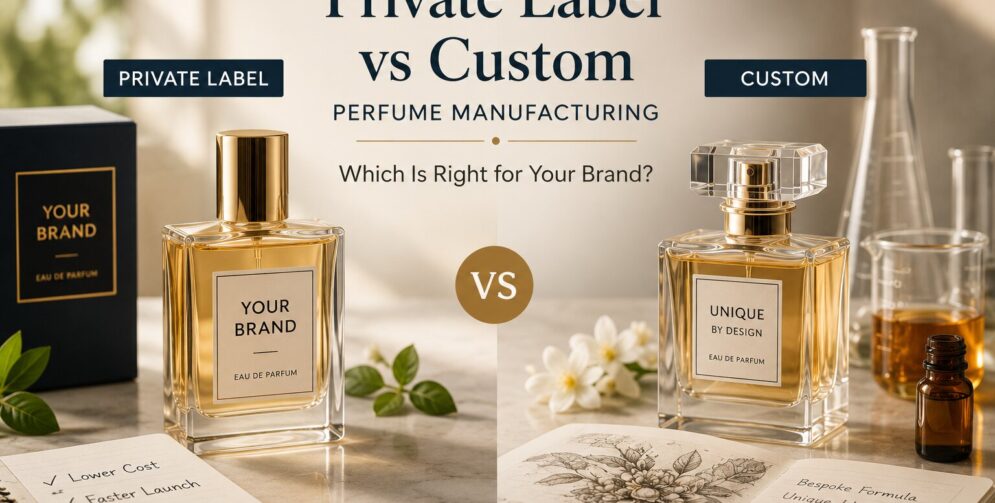
Launching a fragrance brand is an exciting opportunity, especially as the perfume industry continues to grow in India and around the world. However, before you finalize your packaging, marketing strategy, or product lineup, there is one important decision that can significantly influence your startup’s success: choosing between private label and custom perfume manufacturing.
Many entrepreneurs who want to launch a perfume brand assume that manufacturing is a straightforward process. In reality, selecting the right manufacturing model affects everything from startup costs and launch timelines to product uniqueness and long-term profitability.
So which option is better for your business?
The answer depends on your goals, budget, and vision for your brand. In this guide, we’ll compare private label and custom perfume manufacturing, explain their advantages and limitations, and help you determine which path makes the most sense for your fragrance business.
Before deciding between private label and custom perfume manufacturing, it’s equally important to evaluate the manufacturer you’ll be working with. Factors such as production capacity, quality standards, fragrance development capabilities, and packaging support can significantly impact your brand’s success. You can learn more in our guide on How to Choose a Perfume Manufacturer in India.
Understanding the Two Manufacturing Models
Before comparing the two options, it’s important to understand what each model involves.
What Is Private Label Perfume Manufacturing?
Private label perfume manufacturing allows entrepreneurs to sell fragrances that have already been developed by a manufacturer. Instead of creating a new fragrance formula from scratch, you select from existing fragrance options and market them under your own brand name.
A private label perfume manufacturer typically handles fragrance production while allowing you to customize elements such as:
- Brand name
- Logo
- Packaging
- Bottle design
- Product labels
This model is popular among startups because it reduces development time and lowers initial investment requirements.
Key Benefits
- Faster product launch
- Lower startup costs
- Reduced development risk
- Easier inventory planning
- Ideal for first-time entrepreneurs
What Is Custom Perfume Manufacturing?
Custom perfume manufacturing involves creating a completely unique fragrance specifically for your brand.
A custom perfume manufacturer works with you to develop exclusive scent profiles, select fragrance notes, refine formulations, and create a product that cannot be easily replicated by competitors.
This approach gives brands greater creative control and helps establish a distinctive identity in the marketplace.
Key Benefits
- Unique fragrance ownership
- Stronger brand differentiation
- Greater creative freedom
- Premium market positioning
- Long-term competitive advantage
Private Label vs Custom Perfume Manufacturing: Side-by-Side Comparison
Let’s compare the two models across the factors that matter most to startup founders.
1. Initial Investment
Private Label Manufacturing
Private label products generally require a lower upfront investment because fragrance development has already been completed by the manufacturer.
There are no significant research and development costs, making this option attractive for entrepreneurs entering the market with limited capital.
Custom Manufacturing
Custom fragrance development involves formulation, testing, revisions, sampling, and approval processes. These additional steps increase startup costs.
Winner: Private Label
For startups seeking lower investment requirements, private label is often the more accessible option.
2. Time to Market
Private Label Manufacturing
One of the biggest advantages of private labeling is speed.
Since fragrance formulations already exist, businesses can move directly to packaging, branding, and production.
In many cases, products can be ready for launch within weeks.
Custom Manufacturing
Custom development requires extensive fragrance creation and testing before production begins.
This process may take several months depending on the complexity of the project.
Winner: Private Label
If speed is a priority, private labeling offers a much faster route to market.
3. Brand Uniqueness
Private Label Manufacturing
Although packaging and branding can be customized, the fragrance itself may also be offered to other brands.
This can make differentiation more challenging.
Custom Manufacturing
Custom manufacturing creates exclusive fragrance formulations tailored to your brand identity.
This uniqueness can become a major competitive advantage.
Winner: Custom Manufacturing
Brands focused on exclusivity and long-term positioning benefit significantly from custom fragrance development.
4. Creative Control
Private Label Manufacturing
Private-label brands have limited influence over fragrance composition.
Most customization occurs at the packaging and branding level.
Custom Manufacturing
Custom manufacturing gives complete control over:
- Fragrance notes
- Ingredient selection
- Product positioning
- Packaging concepts
- Market differentiation
Winner: Custom Manufacturing
For founders with a specific creative vision, custom manufacturing provides unmatched flexibility.
5. Scalability
Both manufacturing models can support growth, but the approach differs.
Private-label products allow businesses to scale quickly because production systems are already established.
Custom fragrances may require additional planning but often provide stronger brand loyalty as the business grows.
Winner: Tie
The best option depends on your long-term business strategy.
6. Profit Potential
Private-label brands often achieve profitability faster because development costs are lower.
Custom fragrance brands typically require a larger investment upfront but can command higher pricing and stronger customer loyalty over time.
Winner: Depends on Your Goals
Short-term profitability often favors private label, while long-term brand equity often favors custom manufacturing.
When Should You Choose Private Label Perfume Manufacturing?
Private labeling is ideal for entrepreneurs who want to enter the market quickly and efficiently.
You should consider private labeling if:
You’re Launching Your First Brand
First-time founders often benefit from reducing complexity and minimizing risk.
You Have a Limited Budget
Private labeling generally requires less capital than custom fragrance development.
You Want to Test Market Demand
Many entrepreneurs use private-label products to validate their business concept before investing in custom fragrances.
Speed Matters
If you want to launch a perfume brand within a short timeframe, private labeling offers a significant advantage.
You Want Lower Risk
The manufacturing process is already established, reducing operational challenges.
When Should You Choose Custom Perfume Manufacturing?
Custom fragrance development is often the preferred choice for founders building premium or long-term brands.
You should consider custom manufacturing if:
You Want a Unique Fragrance Identity
Distinctive fragrances help create stronger customer recognition.
You’re Building a Premium Brand
Luxury brands often rely on exclusive fragrance formulations to justify premium pricing.
You Have a Long-Term Vision
Custom development supports brand differentiation and long-term growth.
You Want Complete Creative Control
Founders who have a specific vision for their products often prefer custom manufacturing.
You Plan to Build Brand Equity
Unique products create stronger customer loyalty and brand value over time.
Need Help Choosing the Right Manufacturing Model?
Whether you’re planning a private-label fragrance line or developing a custom perfume brand from scratch, choosing the right manufacturing approach can save significant time, cost, and effort. At Hopestone Advisory, we help entrepreneurs navigate fragrance development, manufacturing partnerships, packaging selection, and brand launch planning. Contact our team to discuss the most suitable path for your perfume business.
Common Mistakes Startups Make
Many fragrance startups encounter avoidable problems during the manufacturing selection process.
Choosing Custom Too Early
Some entrepreneurs invest heavily in custom fragrances before validating market demand.
Testing the market first can help reduce financial risk.
Focusing Only on Price
The cheapest option is not always the most profitable.
Quality, reliability, and scalability should also be considered.
Ignoring MOQ Requirements
Minimum order quantities can significantly affect inventory costs and cash flow.
Always understand MOQ requirements before signing agreements.
Overlooking Packaging
Many founders focus entirely on fragrance development while neglecting packaging quality.
Presentation plays a major role in customer purchasing decisions.
Not Planning for Growth
A manufacturer that meets your needs today may not support your requirements tomorrow.
Think beyond the first production run.
How Packaging Influences Your Manufacturing Decision
Packaging is often the first thing customers notice about a fragrance product.
Choosing the right bottles, caps, and packaging materials can significantly influence brand perception and product positioning. Explore our Perfume Bottle & Attar Bottle Solutions to understand how packaging choices can help create a stronger market presence.
Even a high-quality fragrance can struggle in the marketplace if packaging feels generic or low quality.
When evaluating manufacturing options, ask whether your partner can assist with:
- Custom bottle sourcing
- Decorative packaging
- Label design
- Luxury caps
- Gift packaging solutions
Many successful brands work closely with perfume bottle manufacturers and trusted perfume bottle suppliers to create packaging that reflects their market positioning.
Whether you’re launching an affordable fragrance line or a premium luxury collection, packaging contributes significantly to perceived value.
Questions to Ask Any Perfume Manufacturing Company
Before making a final decision, ask every perfume manufacturing company the following questions:
- Do you offer private label services?
- Do you develop custom fragrances?
- What are your minimum order quantities?
- Can I test samples before production?
- Do you assist with bottle sourcing?
- Can you provide packaging support?
- What quality control systems do you follow?
- How scalable is your production capacity?
- What is the typical production timeline?
- Do you offer long-term manufacturing partnerships?
The answers will help you compare suppliers objectively and avoid costly mistakes.
Cost Comparison: Private Label vs Custom Manufacturing
Factor | Private Label | Custom Manufacturing |
Startup Investment | Lower | Higher |
Development Costs | Minimal | Significant |
Time to Launch | Fast | Longer |
Fragrance Ownership | No | Yes |
Product Uniqueness | Moderate | High |
Creative Control | Limited | Extensive |
Risk Level | Lower | Higher |
Long-Term Differentiation | Moderate | Strong |
Manufacturing costs are only one component of your overall investment. Entrepreneurs should also budget for packaging, branding, website development, marketing, inventory, and compliance requirements. For a detailed breakdown, read our Perfume Business Startup Cost Guide.
Which Model Is Best for Launching a Perfume Brand in India?
There is no universal answer because every business has different goals.
Choose Private Label If:
- You are entering the market for the first time.
- Your budget is limited.
- You want to launch quickly.
- You want to test customer demand before investing heavily.
Choose Custom Manufacturing If:
- You want a distinctive fragrance identity.
- You are building a premium or luxury brand.
- Long-term differentiation is important.
- You have the budget to invest in product development.
Interestingly, many successful brands begin with private-label products and later transition to custom fragrance development as they gain market traction.
This hybrid approach allows founders to reduce initial risk while working toward a more unique product portfolio.
Ready to Launch Your Perfume Brand?
From identifying the right perfume manufacturing company to sourcing bottles, caps, packaging, and fragrance solutions, a well-planned launch strategy can make all the difference. If you’re looking for end-to-end guidance, Hopestone Advisory can help you streamline the process and bring your fragrance concept to market with confidence.
Final Thoughts
Choosing between private label and custom perfume manufacturing is one of the most important decisions you’ll make when building a fragrance business.
Private labeling offers affordability, speed, and lower risk, making it ideal for startups and market testing. Custom manufacturing provides exclusivity, stronger branding opportunities, and long-term competitive advantages for businesses committed to building a distinctive fragrance identity.
Rather than asking which model is better, ask which model best supports your business goals.
The right decision depends on your budget, launch timeline, target audience, and long-term vision.
Once you’ve decided whether private label or custom manufacturing is right for your business, the next step is selecting the right production partner. Our guide on How to Choose a Perfume Manufacturer in India explains the key questions every startup should ask before moving into production.
By carefully evaluating both options and partnering with the right manufacturer, you’ll be better positioned to build a successful fragrance brand that can grow and thrive in an increasingly competitive market.